Actor and producer · Telugu cinema
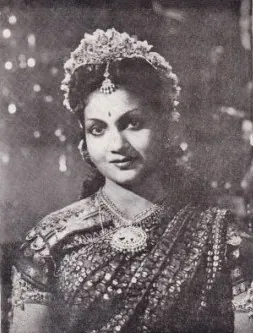
Anjali Devi
Anjali Devi movies: 106 Telugu films on file (106 as actor, 2 as producer), 1947–1995. Earliest on file: Gollabhama (1947). Latest release: Big Boss (15 June 1995).
- Films on file
- 106 (106 as actor, 2 as producer)
- Years on file
- 1947–1995
- Born
- 24 August 1927 · August birthdays (Wikidata)
- Died
- 13 January 2014
- Selected films on file
- Lava Kusha, Aada Pettanam, Allauddin Adhbhuta Deepam
- Record
- Q4765733 on Wikidata
Anjali Devi was an Indian actress and producer in Telugu and Tamil films, active from the late 1940s to the mid-1990s. She is best remembered as Sita in Lava Kusha (1963), the first colour film in Telugu, and for the title roles in Chenchu Lakshmi (1958), Suvarna Sundari (1957) and Anarkali (1955), which she also produced.
She was born on 24 August 1927 in Peddapuram, East Godavari district, as Anjamma, according to Wikipedia, citing The Times of India; Wikidata gives the same date. She took the name Anjani Kumari on stage, and director C. Pullaiah renamed her Anjali Devi. She died in Chennai on 13 January 2014, aged 86.
Career
A theatre artist first, she played Lohitasva in Raja Harishchandra in 1936. Her first film as a heroine, L. V. Prasad’s Kashtajeevi (1940), was abandoned after three reels. C. Pullaiah then cast her as Mohini in Gollabhama (1947), and she became a star almost overnight (The Hindu). Wikipedia says she acted in more than 350 films, most of them in Telugu.
Her early Telugu films include Balaraju (1948), Keelu Gurram (1949), in which she played Mohini, and the title role in Swapna Sundari (1950). In the 1950s she starred in Anarkali opposite Akkineni Nageswara Rao, as Princess Yasmin in Allauddin Adhbhuta Deepam (1957), and in Jayabheri and Bala Nagamma (1959). After Lava Kusha she played Leelavati in Bhakta Prahlada (1967), and she kept working through the following decades. Brundavanam (1992), Anna Vadina (1993) and Police Alludu (1994) were among her last films.
As a producer she made 27 films, including Anarkali, V. Madhusudan Rao’s Bhakta Tukaram (1973) and Chandipriya (1980), with Jaya Prada, Sobhan Babu and Chiranjeevi. She also produced and acted in a television serial on Sathya Sai Baba.
Awards
- Raghupathi Venkaiah Award in 1994 for lifetime service to Telugu cinema, per Wikipedia.
- Tamil Nadu’s Arignar Anna Award (2000), the Ramineni National Award (2006), the ANR National Award (2008) and an honorary doctorate from Nagarjuna University, per Wikipedia.
Personal life
She married the music director P. Adinarayana Rao in 1948, according to Wikipedia, citing The Hindu. Together they produced many Telugu films under the Anjali Pictures banner.
Sources: Wikipedia and the references it cites (linked above), Wikidata, and Tollywood Desk’s film records.
Career on file
Anjali Devi has 106 Telugu films on file at Tollywood Desk, dated from 1947 to 1995: 106 films as actor and two films as producer. The earliest of them is Gollabhama (1947), and the most recent release is Big Boss (1995). The most widely covered of these, counted by Wikipedia language editions, are Lava Kusha (1963), Aada Pettanam (1958) and Allauddin Adhbhuta Deepam (1957). Other recent releases on file are Brundavanam (1992), Nari Nari Naduma Murari (1990) and Ashoka Chakravarthy (1989).
N. T. Rama Rao is the most frequent co-star, sharing 36 films with Anjali Devi, followed by Akkineni Nageswara Rao (34) and Gummadi Venkateswara Rao (34). Among directors, Vedantam Raghavaiah cast Anjali Devi most often, in ten films; next are V. Madhusudhan Rao (9) and Kamalakara Kameshwara Rao (6). Music on 19 of them is by S. Rajeswara Rao, with K. V. Mahadevan (16) and P. Adinarayana Rao (12) next. Anjali Pictures produced eight of them, more than any other banner on file. Across these films the credits on file name 55 different directors, 28 music directors and 104 other credited actors.
Runtime is on file for 73 of them; they average 159 minutes, and the longest is Lava Kusha at 208 minutes. By decade the list splits into 1940s (4), 1950s (26), 1960s (27), 1970s (32), 1980s (14) and 1990s (3).
Figures come from the films on file at Tollywood Desk and change as records are added.