Actor · Telugu cinema
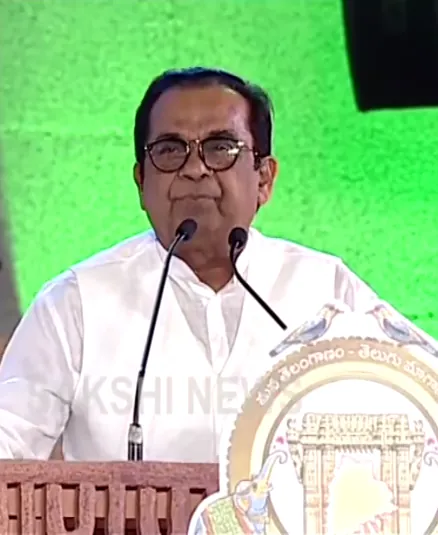
Brahmanandam
Brahmanandam movies: 709 Telugu films on file, 1986–2026. Earliest on file: Rendu Rella Aaru (1986). Latest release: Mahendragiri Varahi (11 September 2026).
- Films on file
- 709 (709 as actor)
- Years on file
- 1986–2026
- Born
- 1 February 1956 · February birthdays (Wikidata)
- Selected films on file
- Magadheera, Kalki 2898 AD, Yevadu
- Record
- Q3765029 on Wikidata
Brahmanandam (born Kanneganti Brahmanandam, 1 February 1956) is an Indian actor and comedian who works in Telugu cinema. He is regarded as one of the finest and highest-paid comic actors in India, and he holds the Guinness World Record for the most screen credits for a living actor, with more than 1,000 films to his name. His honours include the Padma Shri in 2009, six Nandi Awards, two Filmfare Awards and an honorary doctorate from Acharya Nagarjuna University.
Early life and teaching
Brahmanandam was born in Chaganti Vari Palem village near Sattenapalli, in present-day Andhra Pradesh, to Nagalingachari and Lakshmi Narsamma. His father was a carpenter, and he grew up as one of eight children. After earning a Master of Arts degree, he took a job as a Telugu lecturer in Attili, in West Godavari district.
Teaching was not his only outlet. Alongside his lecturing work he performed in theatre and built a reputation as a mimicry artist, which would eventually open the door to television and then films.
From television to films
The novelist and playwright Adi Vishnu introduced him to NCV Sashidhar of Doordarshan, and in 1985 Brahmanandam made his television debut on DD Telugu’s Pakapakalu. Viewers responded well to his work on the show, and it caught the attention of the director Jandhyala, who cast him in Aha Naa Pellanta! (1987). That film became his breakthrough.
It was not, strictly, his first film. He had already acted in Sri Tatavataram and Satyagraham, with Aha Naa Pellanta! being the third he worked on; Sri Tatavataram only reached cinemas in 1988. In 1987 he also appeared in the successful films Pasivadi Pranam and Swayam Krushi.
Building a career in comedy
Over the next few years he became a regular presence in Telugu films, and his work in Vivaha Bhojanambu (1988), Choopulu Kalisina Shubhavela (1988), Bandhuvulostunnaru Jagratha (1989), Muddula Mavayya (1989), Jagadeka Veerudu Atiloka Sundari (1990), Bobbili Raja (1990) and Bamma Maata Bangaru Baata (1990) drew praise.
From 1991 onward his range widened to include a variety of comic parts and a few intense roles. That year he appeared in major films such as Kshana Kshanam and Rowdy Alludu. The Times of India later singled out Chitram Bhalare Vichitram (1991), Jamba Lakidi Pamba (1992) and Yamaleela (1994) as films one never tires of, and Brahmanandam, who appeared in all three, is considered one of the main reasons for their success. In 1992 he played a lead role for the first time, in Babai Hotel.
Khan Dada and the 1990s
His first major award came for playing Khan Dada in Money (1993), which won him the Nandi Award for Best Male Comedian. The film’s success led to a sequel, Money Money (1994), in which he returned to the role. A reviewer at Zamin Ryot praised his performance in Hello Brother (1994).
The rest of the decade brought a long run of successful films, including Alluda Majaka (1995), Intlo Illalu Vantintlo Priyuralu (1996), Bombay Priyudu (1996), Anaganaga Oka Roju (1997), Muddula Mogudu (1997), Bavagaru Bagunnara (1998) and Aavida Maa Aavide (1998). In 2000 alone he appeared in Kshemamga Velli Labhamga Randi, Jayam Manade Raa, Kalisundam Raa and Ammo! Okato Tareekhu.
His own favourites
At a felicitation ceremony in January 2008, Brahmanandam named the films he considered his best eleven. The list mixed his earliest successes with later work: Aha Naa Pellanta!, Vivaha Bhojanambu, Chitram Bhalare Vichitram, Amma, Money, Anna, Pattukondi Chuddam, Anaganaga Oka Roju, Bavagaru Bagunnara, Manmadhudu (2002) and Dhee (2007).
Awards and recognition
The Government of India awarded him the Padma Shri in January 2009 for his contributions to art. His six Nandi Awards cover Money, Anna (Best Supporting Actor), Anaganaga Oka Roju, Vinodam, Ready and Race Gurram. At the Filmfare Awards South he won Best Comedian – Telugu for Manmadhudu, and decades later Best Supporting Actor – Telugu for Rangamarthanda, a role that also brought him an IIFA Utsavam award.
He has collected CineMAA Awards for Best Comedian for films including Manmadhudu, Dhee and Dookudu, and SIIMA Awards for Best Comedian – Telugu for Dookudu, Baadshah and Race Gurram. His work in Attarintiki Daredi won him a TSR – TV9 National Film Award for Best Comedian.
Away from the camera
Brahmanandam is married to Lakshmi, and they have two sons, Raja Goutham and Siddharth. Outside acting he is an amateur sculptor and sketch artist, and he spends his free time reading the philosophical writings of Swami Vivekananda and Jiddu Krishnamurthi.
Career on file
Brahmanandam appears in 709 Telugu films on file at Tollywood Desk, dated from 1986 to 2026. The earliest of them is Rendu Rella Aaru (1986), and the most recent release is Mahendragiri Varahi (2026). The most widely covered of these, counted by Wikipedia language editions, are Magadheera (2009), Kalki 2898 AD (2024) and Yevadu (2014). Other recent releases on file are Ustaad Bhagat Singh (2026), Om Shanti Shanti Shantihi (2026) and Sahakutumbaanaam (2026).
Kota Srinivasa Rao is the most frequent co-star, sharing 173 films with Brahmanandam, followed by Chandra Mohan (79) and Rajendra Prasad (68). Among directors, K. Raghavendra Rao cast Brahmanandam most often, in 40 films; next are E. V. V. Satyanarayana (32) and S. V. Krishna Reddy (31). Music on 74 of them is by Mani Sharma, with M. M. Keeravani (65) and Koti (44) next. Suresh Productions produced 26 of them, more than any other banner on file. Across these films the credits on file name 287 different directors, 138 music directors and 573 other credited actors.
Runtime is on file for 507 of them; they average 148 minutes, and the longest is Nijam at 196 minutes. 110 of them have a streaming (OTT) release noted on the site. By decade the list splits into 1980s (34), 1990s (197), 2000s (259), 2010s (188) and 2020s (31).
Figures come from the films on file at Tollywood Desk and change as records are added.